**Why Material Decisions Carry More Weight Than Drawings Suggest**
Every machined component inherits its behavior from the stock it starts as. Strength, mass, corrosion performance, the coatings it can accept, the tolerance it will realistically hold, and a major share of the unit price all trace back to that single specification. Swap one alloy for another and the quotation changes, the delivery date shifts, and occasionally the geometry itself has to be reworked. Few decisions on a drawing ripple through a project the way this one does.
**Start With the Operating Environment, Not a Familiar Alloy**
Most failed material choices share the same origin: an engineer defaults to a grade they already know, then discovers far too late that it cannot be anodized, drifts out of tolerance after heat treatment, or costs four times the project budget.
A more dependable workflow reverses that order. Before naming any grade, document what the part must actually survive:
- Mechanical loads, stiffness demands, and wear conditions
- Temperature range and chemical or moisture exposure
- Weight targets and conductivity requirements
- Cosmetic expectations and coating plans
- Annual volume and per-part cost ceiling
In practice, two or three of these constraints dominate, and those few effectively choose the material for you. Writing them down first turns selection from guesswork into simple elimination.
**The Four Metal Families Behind Most CNC Work**
Metals handle the majority of machined parts because they combine rigidity, dimensional stability, and predictable behavior under the cutter. Nearly all of that work falls into four groups.
*Aluminum* is the default for prototyping and a large share of production. It cuts quickly, holds dimension well, weighs roughly a third of what steel does, and anodizes beautifully. The catch is that grade matters more than most drawings admit. A callout reading simply "aluminum" forces the shop to guess—usually 6061-T6—and guesses invite surprises at inspection. Aluminum grades differ as much in finish behavior as in strength, so always name the alloy and temper. When strength-to-weight is critical and the part will be coated or protected, 7075 earns its premium; for everything else, 6061 remains the practical answer, since 7075 brings weaker corrosion resistance, no realistic weldability, and noticeably higher stock cost.
*Stainless steel* earns its place when corrosion resistance, structural strength, or sterilization requirements outweigh machining speed.
*Carbon steels* deliver more strength per dollar than almost anything else. 1018 machines predictably and welds easily, 1045 offers higher strength and accepts induction hardening, and 4140 is the tough alloy standard for shafts, gears, and fixtures. All of them rust, so plating, black oxide, or paint belongs in the specification from the start—not appended at the end.
*Brass, copper, and titanium* form the specialty tier. Brass C360 offers the best machinability of any common metal, making it ideal for high-volume turned parts and fittings. Copper C110 leads on electrical and thermal conductivity but cuts gummy and demands sharp tool geometry. Titanium Ti-6Al-4V provides the best strength-to-weight ratio in common use plus biocompatibility, priced accordingly: slow cutting speeds, heavy tool wear, and material costs well above steel. It appears mainly in aerospace and medical programs where weight or biocompatibility justifies the expense.
**Where Machinable Plastics Win Outright**
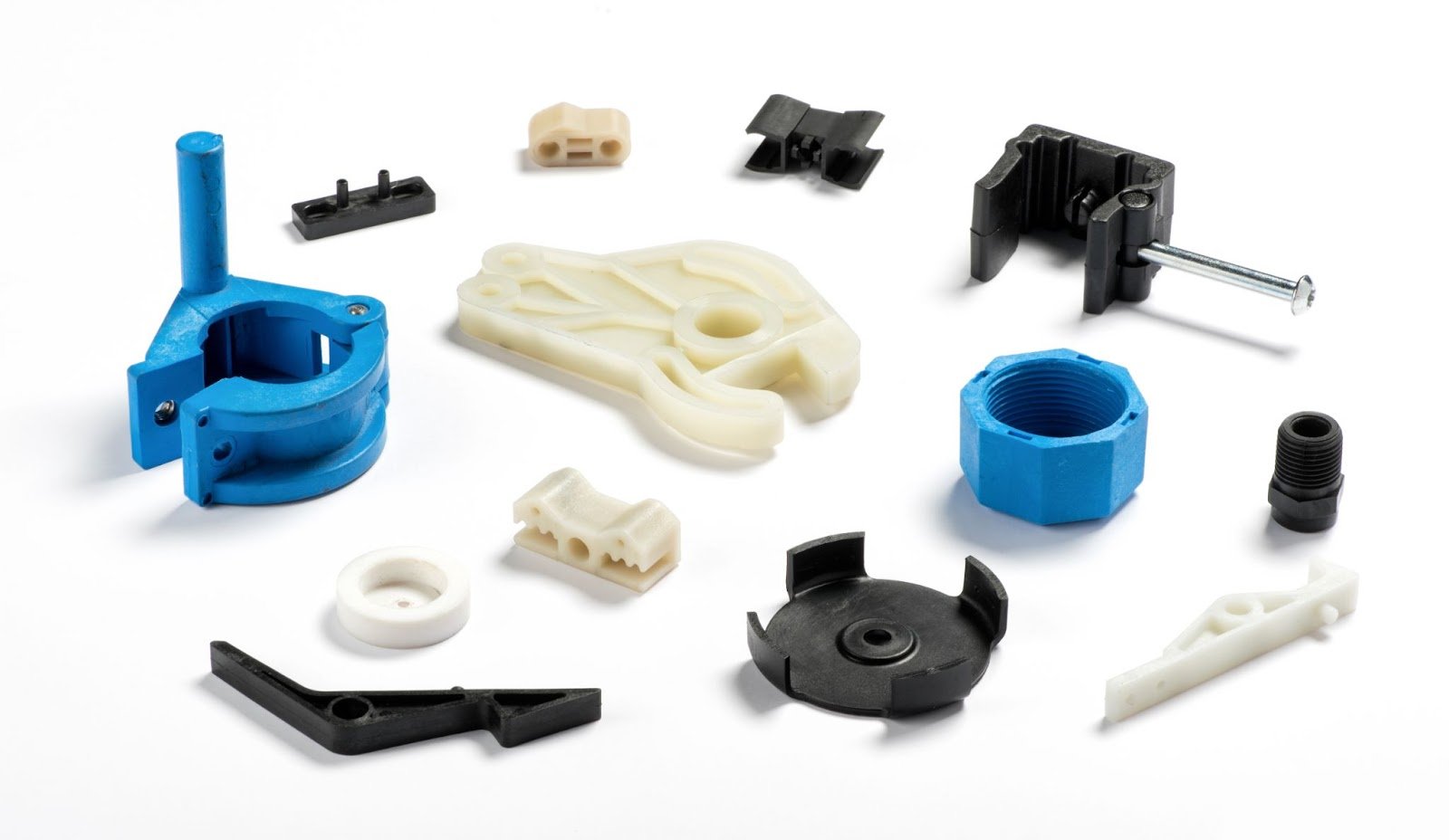
Engineering plastics are not a budget compromise—they are the correct answer when a part needs electrical insulation, chemical resistance, low friction, minimal weight, or optical clarity. Acetal and nylon cover most mechanical applications, while PEEK and PEI enter the discussion when temperature or chemical exposure eliminates the cheaper resins.
The tradeoffs deserve respect. Most machinable plastics hold tolerances around ±0.1 mm rather than the ±0.01 mm typical of metals. They expand and contract with temperature and humidity, and machining releases internal stress, so thin or asymmetric features can warp after the cut. When a design calls for large flat panels or intricate internal channels, 3D printing often beats machining from solid stock.
**Cost: Machine Time Matters More Than Stock Price**
Material cost per pound is only part of the picture. The larger driver is how long the part occupies the machine, and difficult alloys multiply cycle time fast. A useful habit: when a part is not weight- or strength-critical, quote it in both the preferred alloy and 6061-T6. The gap is frequently larger than the design benefit. Reviewing available stock on the XC Machining materials page before finalizing a drawing also prevents specifying a grade saddled with a four-week lead time.
**Finish Compatibility: The Constraint That Appears Last**
Surface finishing surprises more design teams than any other factor, because it only surfaces at the end of the project. Anodizing requires aluminum or titanium, passivation applies to stainless steel, and electroplating demands a conductive substrate. Even color matters—if the part must be clear anodized in a specific dye, that choice constrains the alloy, since different aluminum grades absorb dye differently. Reviewing surface finishing options alongside the material decision keeps both choices compatible and avoids a late redesign.
**Making Selection Routine—and Scaling Beyond Prototypes**
Material selection becomes straightforward once it follows a fixed sequence: define constraints, shortlist candidates, verify finish compatibility, confirm stock availability, then lock the grade and temper on the drawing.
For teams moving toward volume, one more step matters. Once annual quantities climb past a few thousand units, compare the machined design against injection molding, since both the material shortlist and the geometry will change. Engineers weighing several candidate grades can also send drawings to XC Machining for machinability feedback before committing to stock.
**Frequently Asked Questions**
*Which CNC machining materials are used most often?*
Aluminum 6061-T6 leads by a wide margin. It machines quickly, holds tight tolerances, resists corrosion, anodizes well, and costs less than most alternatives—making it the default for prototypes, brackets, housings, and general mechanical components across nearly every industry.
*Can CNC machined plastics hold the same tolerances as metal?*
Generally no. Typical achievable tolerances on machinable plastics run around ±0.1 mm, compared with ±0.01 mm or tighter on metals. Softer plastics deflect under cutting forces and shift with temperature and moisture.
*How do I choose between 6061 and 7075 aluminum?*
Choose 7075 when strength-to-weight is critical and the part will be coated or protected. Choose 6061 for everything else. 7075 offers higher strength but weaker corrosion resistance, no practical weldability, and a noticeably higher stock cost.
*Does material choice affect available surface finishes?*
Yes, significantly. Anodizing requires aluminum or titanium, passivation applies to stainless steel, and electroplating needs a conductive substrate. Choosing the finish and material together prevents a late redesign when the intended appearance turns out to be impossible.
*What information should I include on the drawing?*
Specify the alloy, grade, and temper or condition—6061-T6 rather than "aluminum." Add any material specification, heat treatment, certification requirement, and the finish callout with the surfaces it applies to.