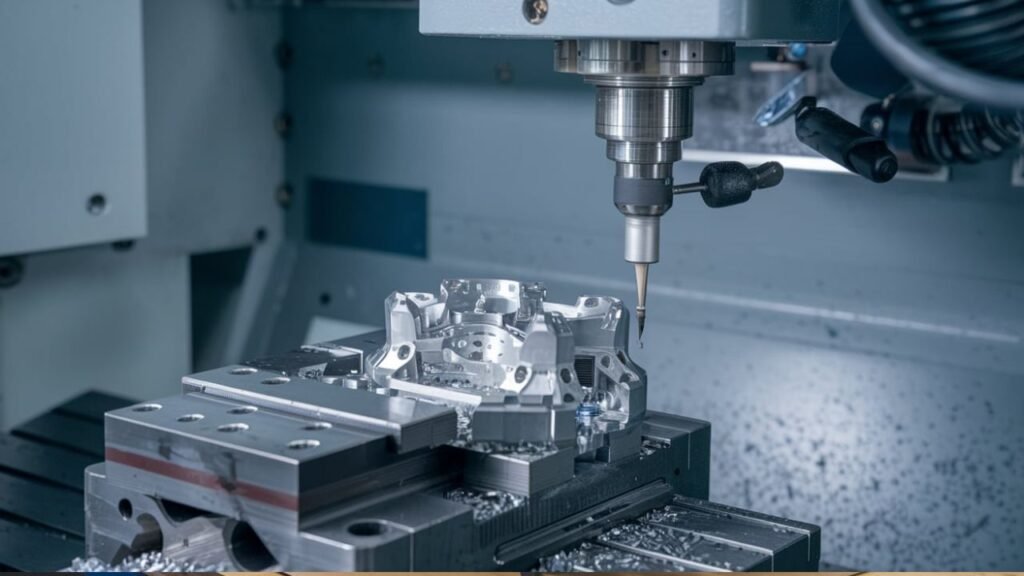
Many engineers assume that because 7075 aluminum is nearly twice as strong as 6061, it must be difficult to cut. This is a widespread misconception. In reality, 7075 is exceptionally easy to machine. Its higher hardness prevents the gummy smearing typical of softer alloys, resulting in clean fracturing and excellent chip control. With standard carbide end mills, production floors routinely achieve mirror-like finishes and hold extremely tight dimensional tolerances. The perceived difficulty rarely stems from the cutting action itself, but rather from how the material behaves during and after removal.
While the actual shearing process is straightforward, successful fabrication requires anticipating three primary variables. First, the alloy’s tensile strength accelerates edge dulling compared to commercial grades. Second, its zinc-based composition drives up raw material expenses, making it a strategic investment rather than a default specification. Third, and often the most costly oversight, is residual stress. Standard plate locks in tension from manufacturing. As you strip away material, that equilibrium shifts, which can cause thin profiles or large flat surfaces to bow or twist once clamped pressure is released.
Preventing distortion demands a disciplined workflow. Always specify T651 temper stock, which undergoes mechanical stretching after solution heat treatment to neutralize internal forces. Pair this material choice with a two-stage approach: remove bulk material evenly across opposing faces first, allow the blank to settle, then execute light final passes to final dimensions. Avoid machining one side completely before addressing the opposite face, as asymmetric removal guarantees warpage. For critical flatness applications, consider allowing parts to rest between stages or introducing a low-temperature stress-relief cycle.
Cutting parameters should prioritize heat management and rapid chip evacuation. Run sharp, polished-flute carbide inserts at high spindle speeds using aggressive flood coolant or targeted air blasts. Climb milling significantly improves surface quality while reducing cutting friction. Although tool replacements will occur more frequently than with softer metals, maintaining optimal lubrication and preventing built-up edge preserves both geometric integrity and production schedules. These fundamentals mirror standard aluminum practices, adjusted only for the expectation of shorter tool life.
Ultimately, material selection should align strictly with functional requirements. Reserve 7075 for aerospace structures, load-bearing brackets, and precision tooling where maximum strength-to-weight ratios are non-negotiable. For enclosures, jigs, cosmetic covers, or assemblies requiring welding and marine exposure, switch to 6061 or 6063. These alternatives deliver ample mechanical performance at a fraction of the cost, alongside superior corrosion resistance and effortless fabrication.
At XC Machining, our engineering team fabricates high-strength aluminum components daily, maintaining ±0.005 mm accuracy through controlled staged processes and advanced 5-axis setups. Whether you require structural reinforcement or complex geometries, our protocols eliminate surprise warping and maximize yield. Upload your CAD files today to receive a precise quote tailored to your tolerance and volume requirements.