For any quality engineer preparing to add a CNC machining supplier to an approved vendor list, IATF 16949 certification is the starting line — not the finish. The real risk sits in the space between a shop that owns the certificate and one that actually runs an automotive-grade manufacturing system. That gap is where warranty claims are born.
IATF 16949 is the most demanding quality management standard in manufacturing, written specifically for the automotive supply chain's zero-defect culture, customer-specific requirements (CSRs), and first-time-quality expectations. The practical test is simple: if a supplier cannot deliver a complete Production Part Approval Process (PPAP) package — including a full 300-piece capability study with Cpk ≥ 1.67 — they are not operating at IATF 16949 level, certificate or not.
**Why automotive CNC machining is a different discipline**
Volume is what separates automotive work from everything else. Powertrain components are produced at 50,000 to 500,000 units per year, with zero-defect targets and 100% traceability back to the raw material heat lot. The tooling strategies, statistical process control (SPC) demands, and documentation discipline required at that scale are categorically different from prototype or general engineering machining.
This guide walks through what IATF 16949 actually requires on the CNC shop floor, the PPAP documentation automotive buyers expect, tolerance and material standards, and a qualification framework engineering teams can apply before approving any new automotive CNC source.
**The PPAP gate: 18 elements, one signature**
PPAP is the formal documentation checkpoint between development and production in the automotive supply chain. Most OEMs and Tier 1 primes require Level 3 PPAP — the complete 18-element package plus physical sample parts — before a new supplier is released to production.
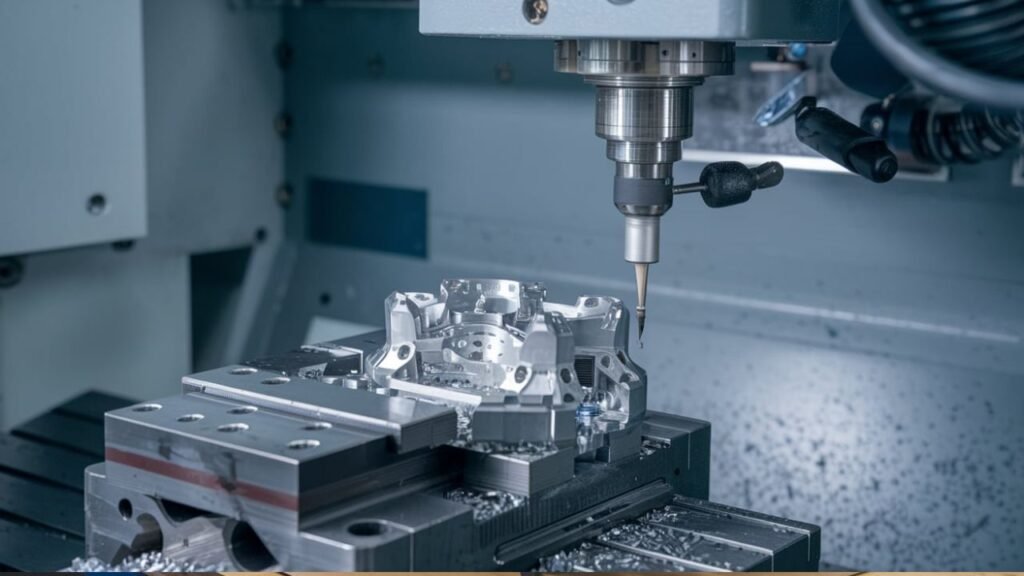
XC Machining's CNC machining service team has managed full Level 3 PPAP submissions for automotive Tier 1 clients across powertrain, chassis, and electronics housing applications, providing PFMEA, Control Plan, 300-piece capability study, and PSW as standard on new automotive part submissions. Our 5-axis CNC machining centres hold ±0.005 mm on bore and positional features for transmission and brake caliper applications, with CMM-verified capability studies documented for PPAP submission.
**Four drawing decisions that make or break a PPAP**
*Datum structure.* Automotive GD&T depends on a clear primary/secondary/tertiary datum hierarchy. Parts submitted without a complete datum reference frame force suppliers to interpret intent — and different interpretations produce different parts on different fixtures. This is one of the leading causes of dimensional disagreement between supplier and customer measurement results. Lock the datum hierarchy before the drawing is released.
*Special characteristics assigned too broadly.* Calling out ±0.005 mm on a clearance hole that assembles with 0.5 mm of clearance forces SPC and Cpk verification on a feature with no functional consequence. It inflates the PPAP burden, raises per-part inspection cost, and consumes SPC capacity on non-critical dimensions. Reserve special characteristics for features where out-of-tolerance genuinely affects function, safety, or regulatory compliance.
*Bilateral versus unilateral tolerances.* A transmission gear bore dimensioned as 25.000 ± 0.005 mm reads as bilateral. If the interference fit actually requires 25.000 to 25.005 mm (unilateral, all positive), that bilateral callout creates ambiguity, producing incorrect Cpk calculations and potentially out-of-spec assemblies. Use unilateral notation (+0.005/−0.000) wherever direction matters.
*Heat treat left out of the sequence.* Parts that are case hardened, induction hardened, or through hardened after machining shift dimensionally during the process. Without post-machine stock — typically 0.05 to 0.15 mm depending on part size and process — plus a final finish-grind or ream operation, the part will fall out of tolerance after heat treat. The PPAP must document the complete manufacturing sequence, including post-heat-treat finishing.
**Key terms, defined**
**IATF 16949:2016** was developed for the automotive supply chain by the International Automotive Task Force, whose members include BMW, General Motors, Ford, Stellantis, Volkswagen, Renault and others. It layers automotive-specific requirements — APQP, PPAP, PFMEA, SPC, MSA and customer-specific requirements — on top of ISO 9001. It is the mandatory quality certification for direct suppliers to automotive OEMs and most Tier 1s worldwide. ISO 9001 alone will not get you into the direct automotive supply chain.
**PPAP** is the formal quality approval gate a part must pass before entering production supply. It comprises up to 18 defined elements proving the manufacturing process can consistently produce a part meeting every engineering requirement. Level 3 — the full package plus physical samples — is the norm for new CNC machined automotive parts, and includes a 300-piece capability study demonstrating Cpk ≥ 1.67 on all special characteristics designated by the OEM or Tier 1.
**Cpk** measures how well a process is centred within its tolerance band relative to its variation. A Cpk of 1.33 corresponds to roughly 64 defective parts per million at steady state; 1.67 corresponds to approximately 1 ppm — the automotive benchmark for special characteristics flagged as safety-critical or dimensionally critical. Reaching Cpk ≥ 1.67 demands tight process control: consistent fixturing, managed tool wear, and real-time SPC monitoring. Capability data must come from a production run of at least 300 pieces.
**Can a non-certified shop supply automotive parts?**
Technically, yes — a supplier without IATF 16949 can feed a Tier 1 or Tier 2 that manages quality on its behalf. In practice this is the exception, usually limited to commodity items or early development phases. For series production parts entering the automotive supply chain, IATF 16949 remains the standard requirement. Non-certified suppliers cannot submit a valid PPAP independently and are generally blocked from OEM-approved supplier lists.
XC Machining provides IATF 16949-aligned CNC machining with full PPAP package capability. Submit your automotive part drawings for a DFM review at xcmachining.com.